STU-2025 / process case
- Format
- Wall-scale image installation
- Scale
- 23 × 8 feet
- Instagram displayed date
- September 2, 2025
Cybersecurity wall
A room-scale image built through AI seeds, desktop composition, physical printing, scanning, and AI-assisted enlargement.
- 23 ft
- Source-stated width
- 8 ft
- Source-stated height
- 184 ft²
- Calculated image area
- 2025
- Public post year
A 23 × 8-foot image in a cybersecurity setting
The public @sicxz post identifies the work as a 23-foot-wide by 8-foot-high wall at EWU Catalyst, in the cybersecurity department. Instagram displays the post date as September 2, 2025 in Pacific time.
The source gives both an installed scale and an unusually specific production chain, making the work legible as an image and as a sequence of transformations.
Seed → compose → print → scan → enlarge
The caption describes a hybrid workflow in which generative assistance is one part of a longer graphic-design process. The physical print-and-scan stages sit between desktop composition and final enlargement.
- 01 / AI seedMidJourney image seedsSource-stated
- 02 / composeAdobe PhotoshopSource-stated
- 03 / physicalSmall-format printsSource-stated
- 04 / recaptureHigh-resolution scansSource-stated
- 05 / AI enlargeTopaz Labs Gigapixel + ON1 Resize AISource-stated
Public installation image
Observed media / Instagram permalink
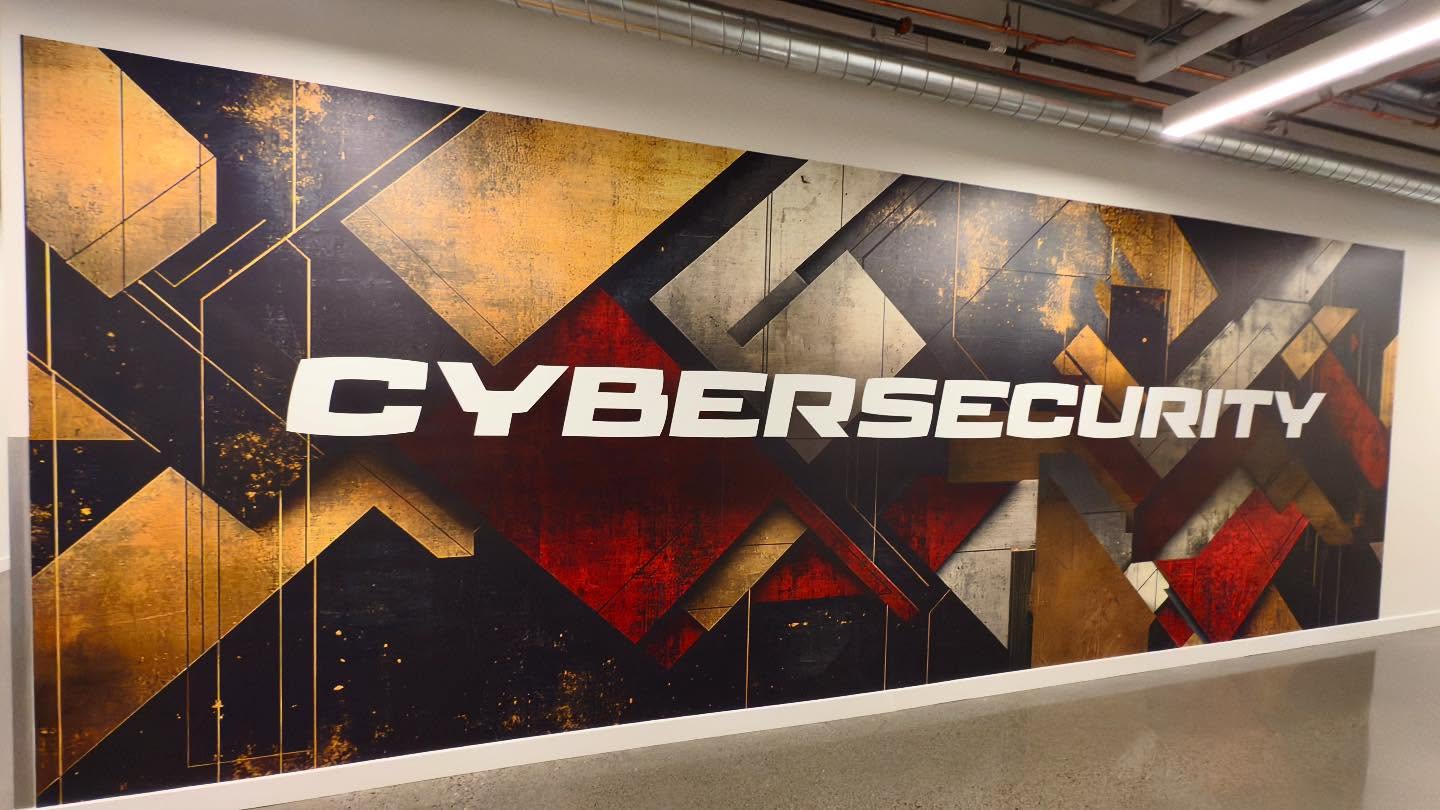
What the process makes visible
Observed media
The public image presents a continuous image field at wall scale, read in relation to the surrounding room rather than as a small framed object.
Source-stated process
The caption discloses generative seeds, Photoshop composition, small prints, high-resolution scans, and two AI-assisted enlargement tools.
Inference
The print-and-scan interlude can be read as a material translation layer: the final wall carries not only generated and composited imagery, but also the optical and physical consequences of moving out of and back into the computer.